Using the Language Processing Hierarchy and Blooms Taxonomy for Speech Therapy IEP Goals

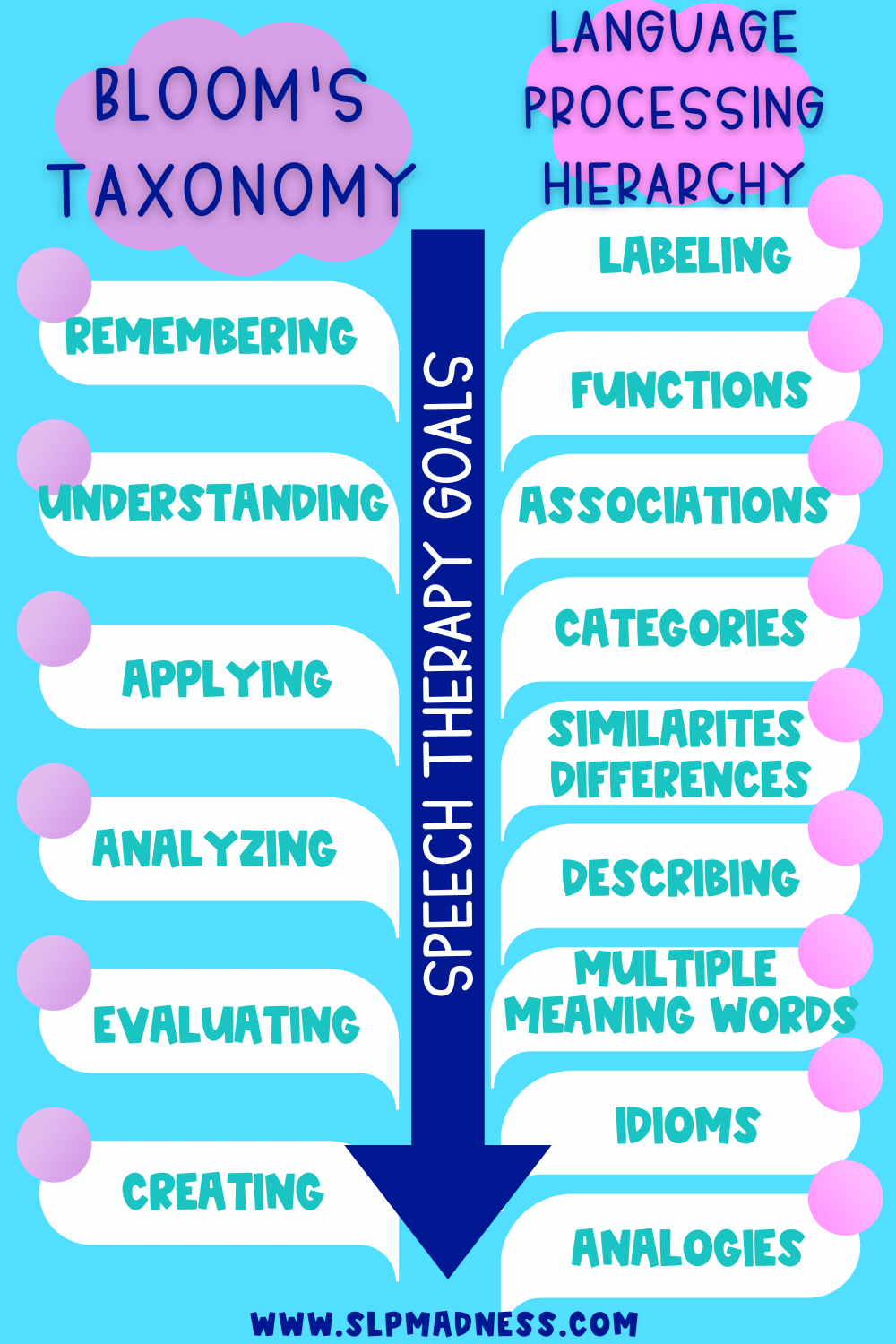
This post is written to help speech therapists better understand the language processing hierarchy and Bloom’s Taxonomy and how they may be used to write speech therapy IEP goals when evaluating and treating students. Both frameworks provide a language development hierarchy for higher-level language goals for speech therapy.
Understanding the Overlap Between the Language Processing Hierarchy and Bloom’s Taxonomy for IEP Goals
Hey there! As a Speech Therapist, you are always considering your students’ language strengths and needs when writing speech and language IEP goals and objectives.
That’s why understanding both the Language Processing Hierarchy and Bloom’s Taxonomy can help with speech therapy decision-making for IEP goals and instruction. In your quest to help students make progress, you can harness the power of two powerful frameworks: the Language Processing Hierarchy and Bloom's Taxonomy.
By understanding how these frameworks intersect and overlap, you can write strong language goals that simultaneously target language complexity and cognitive growth. Read about both frameworks and discover how they can be used to write effective speech therapy IEP goals.
Understanding the Language Processing Hierarchy:
The Language Processing Hierarchy provides us with a roadmap to understand how individuals process and produce language. Using the language processing hierarchy is an effective way to write speech therapy IEP goals.
Labeling
At this level, the language students may have a goal for working on labeling items in the environment, understanding common labels for items, and using labels in conversation. You will want your students to also understand that a plastic bottle that contains water is the same as a bottle that contains juice.
Functions
Students will work on understanding the purpose of objects, people, and actions. Specifically, understanding the functions of common items, such as the purpose of a toothbrush, and using functional language in conversation. A speech therapy goal would be for students to begin to construct agent + action phrases or sentences and understand the action associated with a noun they know.
Associations
Activities that promote word association skills can greatly enhance language processing. Encourage students to connect words with their related sounds (phonology) and meanings (semantics). For instance, play a game where students generate words that start with the same sound or share a semantic category. A goal for students would be to match pictures based on what is commonly used together. An extension would be for students to explain why the two associated items go together.
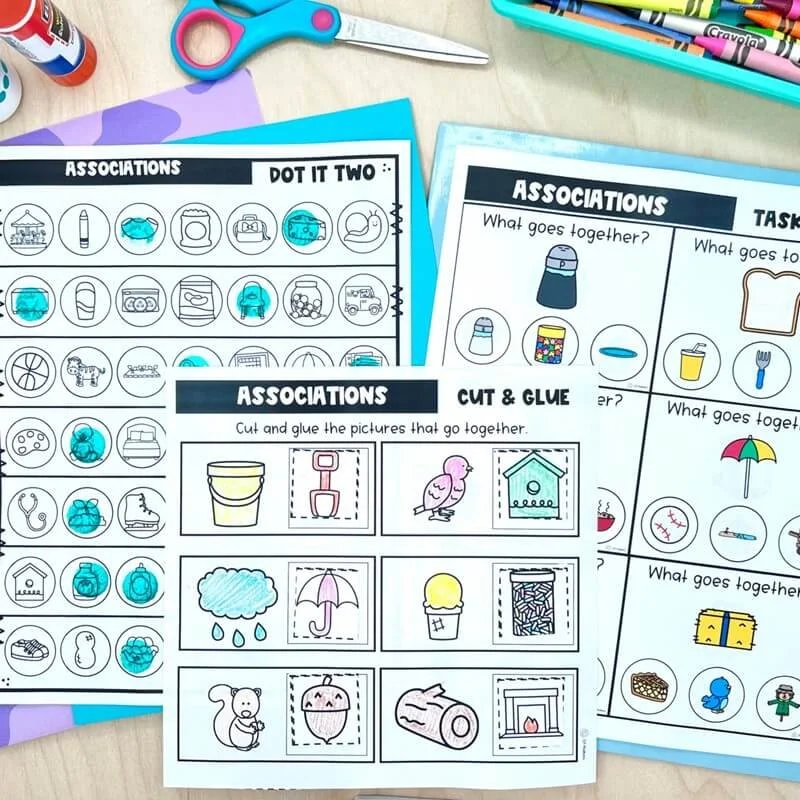
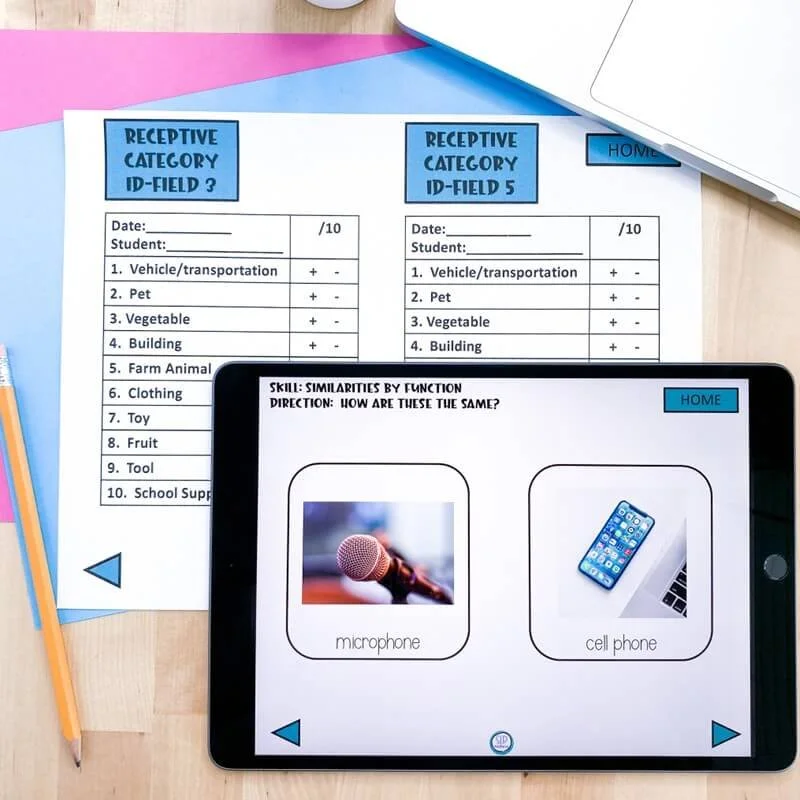
Language Processing Skills Data Collecton
Categorization
Help students develop categorization skills by organizing words based on specific criteria. Provide them with a list of words and ask them to sort them into groups based on shared characteristics. This activity strengthens their ability to identify and classify words.
Similarities and Differences
Engage students in exercises that encourage them to identify and explain similarities and differences between words, objects, or concepts. This activity enhances their understanding of relationships and critical thinking. Compare and contrast speech therapy goals are an important language skill to target.
Describing
Encourage students to practice descriptive language by providing detailed explanations of objects, events, or people. Guide them in using appropriate vocabulary, sentence structures (syntax), and adjectives (semantics) to paint a vivid picture through words.
Multiple Meaning Words:
Multiple-meaning words can be challenging for students. Being able to define words based on the context of use is a critical language development skill. Create activities that focus on differentiating between the various meanings of a word in different contexts. This helps students refine their understanding of semantic nuances.
Idioms
Introduce idioms to students and engage them in activities that explore their figurative meanings. Help students decipher idiomatic expressions and encourage them to use them appropriately in context. This activity enhances their understanding of social communication and figurative language.
Analogies
This level involves understanding relationships between words and concepts in sentence form.
Students may work on understanding analogies, such as “apple is to fruit as carrot is to vegetable,” as it provides them the opportunity to synthesize all of the levels of the language processing hierarchy into a higher level language skill showing mastery of the lower levels.
Exploring Bloom's Taxonomy:
Now, let's dive into Bloom's Taxonomy—a renowned framework that categorizes cognitive skills according to their complexity and depth. You’ll discover how it aligns with the language processing hierarchy.
Remembering
Similar to labeling, this level supports students in recalling and reproducing information. This skill starts at the level of vocabulary recall and word finding.
Understanding
Encourage students to comprehend and interpret language. This level aligns with the Function and Association levels of the Language Processing Hierarchy. When you write IEP goals for those skills, along with WH questions you begin to work at this level of Bloom’s Taxonomy.
Applying
Guide students in applying language skills beyond the concrete. This involves the skills of similarities and differences, answering explicit and implicit questions, and self-generated narrative language and stories.
Analyzing
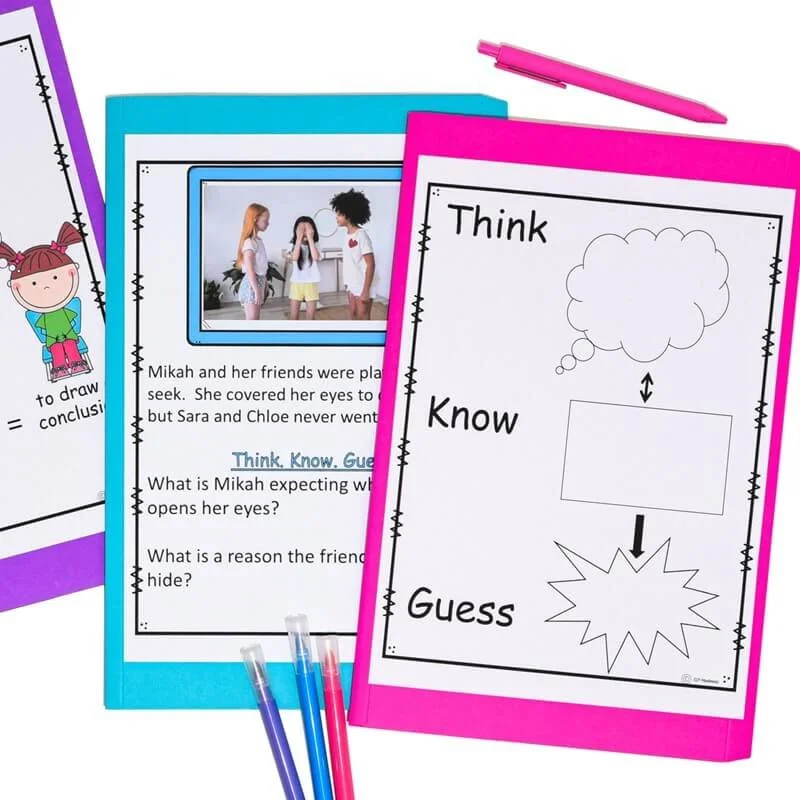
The skills of using context clues to define vocabulary for multiple-meaning words and using context clues to make inferences occur at this level as they promote critical thinking. Engaging students in activities that require them to analyze language elements are important for analyzing skills.
Evaluating
Encouraging students to evaluate language usage and express their opinions occurs at this level. Targeting perspective-taking, understanding social inferences, and implicit social communication skills are important to target at this level. Working on language organization goals provides incorporates the higher-level skills of Bloom’s Taxonomy.
Creating
This is your ultimate goal for your students. When students are self-generating language across syntax, semantics, and pragmatics they are working on this level of Bloom’s Taxonomy. Empower students to demonstrate their language proficiency and creativity, no matter their language level and chronological age. Encourage them to compose self-generated language that is appropriate for their age and language level.
As a speech therapist, you play a crucial role in supporting students' language development and cognitive growth. By recognizing the overlap between the Language Processing Hierarchy and Bloom's Taxonomy, you can design speech therapy IEP goals and objectives and speech therapy activities that foster improving language skills and higher-order thinking.