Language Processing Hierarchy: The Importance for Speech Therapists
This post is written to help speech therapists better understand the language processing hierarchy and how it may be used to evaluate and treat our students.
The Language Development Hierarchy for Assessment & Treatment
Hey there! As a speech therapist, you already know that language development is a complex and multi-layered process.
That's why understanding the language development hierarchy is crucial for speech therapists. It's basically a model that outlines the levels of language processing, from labeling words to more abstract language processing. By understanding this hierarchy, we can make sure that we're covering all the key components of language processing in our IEP goals and speech therapy activities.
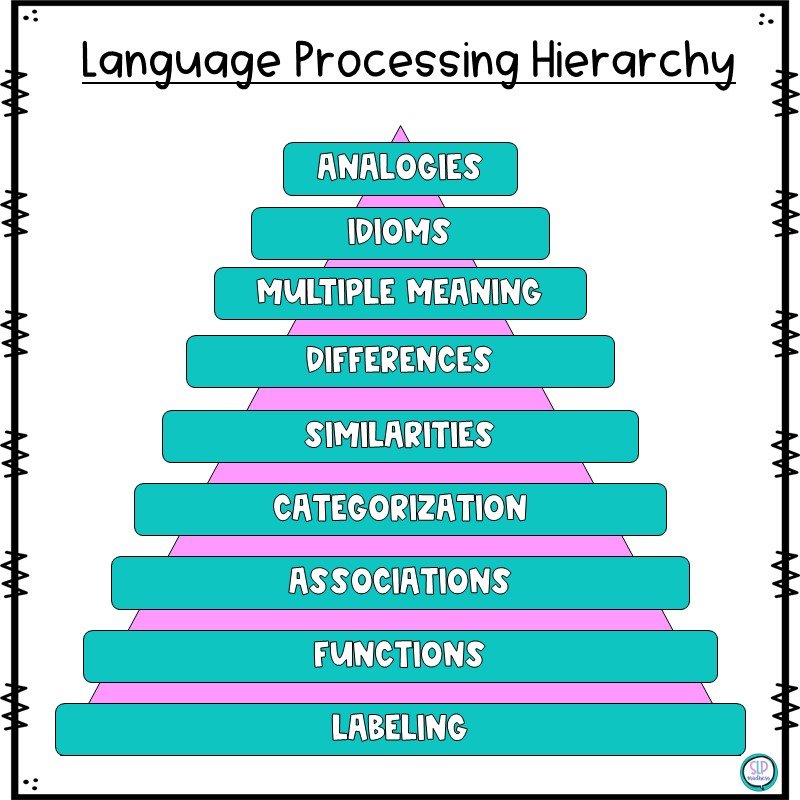
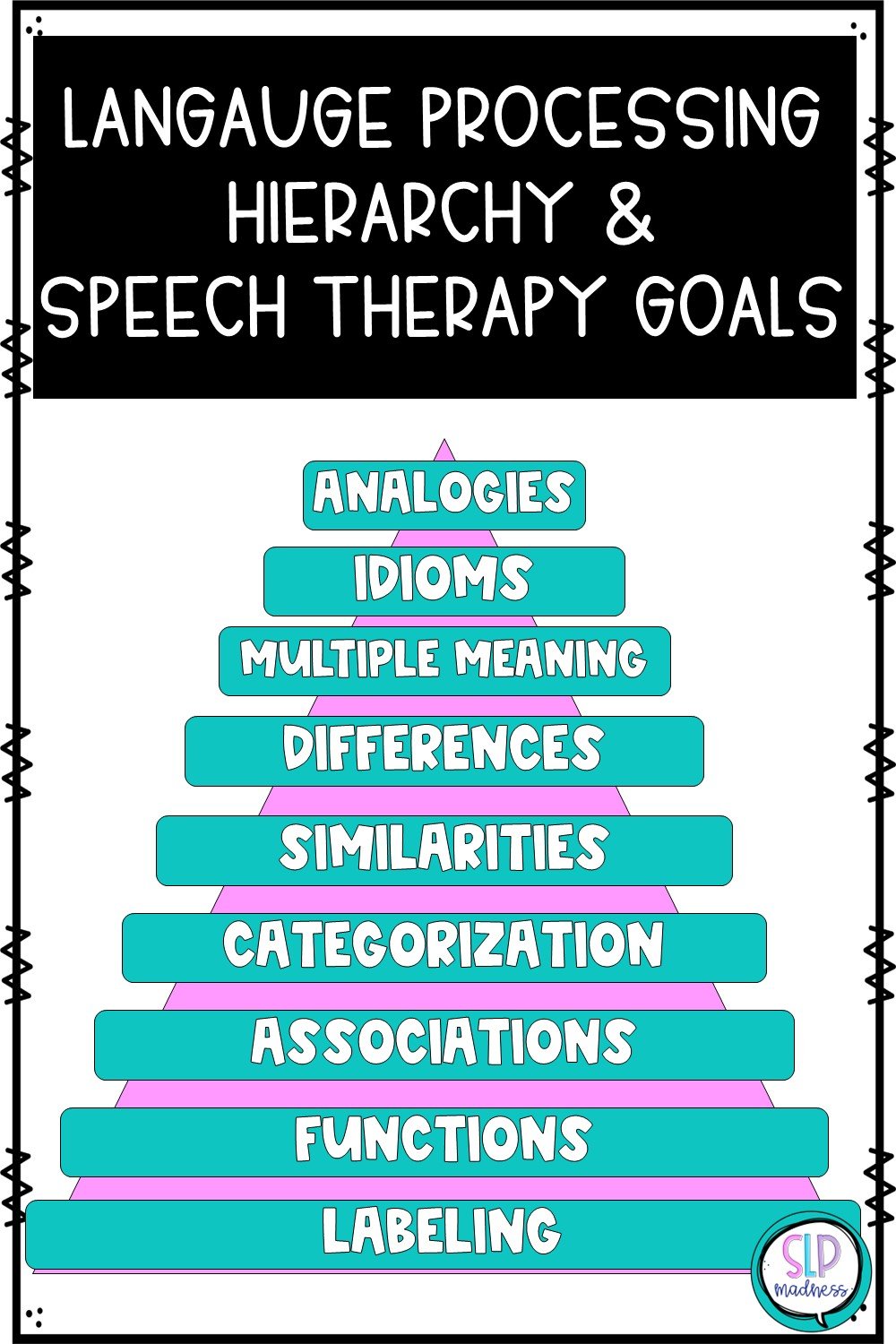
Use this language processing chart to view the language hierarchy levels and goals.
Labeling
This level involves the ability to name objects, people, and actions.
At this level, the language goal is for children to work on labeling items in the environment, understanding common labels for items, and using labels in conversation. You will want your students to also understand that a plastic bottle that contains water is the same as a bottle that contains juice.
Functions
This level involves understanding the purpose of objects, people, and actions.
Students will work on understanding the functions of common items, such as the purpose of a toothbrush, and using functional language in conversation. A speech therapy goal would be for students to begin to construct agent + action phrases or sentences and understand the action associated with a noun they know.
Associations
This level involves connecting words with their corresponding words based on use.
A goal for students would be to match pictures that have word associations and begin to be able to name “what goes together” on their own. An example would be for students to match a picture of a dog with a leash (2 nouns) and be able to expressively state that they need the leash for their dog.
Free Associations Data Collection Probe with Speech Therapy Data Sheets
Categories
This level involves grouping objects, people, and actions based on shared characteristics.
This is the level the goal is for students to be able to categorize words and objects based on the group they belong to. Goals can vary by student and include convergent and divergent naming.
Some students will work on this crucial language-processing skill by
sorting objects by category,
categorize by verbally naming items that belong in a category (convergent naming).
This may first look like broad categories, such as food, animals, and clothing but as students progress on the hierarchy of language speech therapists should begin to have students work on the categorization of sub-categories (i.e., fruit, vegetables, etc.).
Other students may need an IEP goal for divergent naming which would include naming items that belong to a specific category label.
I recommend spending a lot of time working at this level of the language processing hierarchy!
Similarities and Differences

This crucial level involves comparing and contrasting objects, people, and actions.
As the language processing hierarchy goals reach this level, students begin to apply their mastery of the lower levels to begin to compare and contrast by explaining similarities and differences. The goal of this step should be that students are able to use the function, categorization, and associated features to explain how things are the same and different.
Another way to target similarities and differences is with the vocabulary words themselves and provide direct instruction on antonyms and synonyms.
Multiple Meanings
This level involves understanding that words can have multiple meanings, such as “bank” as a financial institution or a riverbank. This is where students begin to learn that they must use context clues to understand these types of words.
For students working on understanding words with multiple meanings, they may have language goals that focus on homonyms. Homographs and homophones can both be targeted. Language processing goals will start to teach context clues as part of a student’s language development.
Idioms
This level involves understanding figurative language, such as idioms and expressions.
Students may work on understanding common idioms, such as “the ball is in your court,” and using idioms in conversation. Even simple phrases used commonly in the classroom, such as “take a seat,” can be difficult for students with language processing disorders to understand in conversation. Specific language goals would include both comprehension and expression of idiomatic expressions.
Analogies
This level involves understanding relationships between words and concepts in sentence form.
Students may work on understanding analogies, such as “apple is to fruit as carrot is to vegetable,” as it provides them the opportunity to synthesize all of the levels of the language processing hierarchy into a higher level language skill showing mastery of the lower levels.
So, by working on all these language processing components in our students’' IEP goals, we're giving them the comprehensive language development support they need.
By targeting each level of the language processing hierarchy, we're helping our students build a strong foundation for effective language processing and communication. And that's what it's all about, right? Making sure our students have the tools they need to succeed.