
Speech Therapy Data Collection Made Easy!
What if I told you that making a few simple tweaks to your speech therapy data collection system would reduce your paperwork demands AND make your lesson planning easier?

Simple Speech Therapy Data Collection
Below is an outline of a 4-step speech therapy data tracking process that will free you from the burden of data charting while simultaneously doing therapy.
Read on to learn the steps toward easy and meaningful speech therapy data collection.
And download the free sample here!
This system starts with one very important principle-
Treatment does not equal testing!
That means you can put down your post-its and pens and stop charting during your speech therapy activities.
Speech Language Pathologists are clinicians. What we do is rooted in treatment but that is not where the road begins. Our road begins with a comprehensive evaluation and assessment to determine what skills are deficient.
The 4 Steps to Speech Therapy Data Collection
Once the comprehensive speech therapy evaluation is complete, you will move on to STEP 1 of this data collection method.
STEP 1: Establish a Baseline Using Data Collection Probes
Baseline data is the foundation. Collect this information by using skill-based probes for the skill(s) identified as areas of need on your assessment.
I recommend using 10-item probes for your baseline. For example, if my student’s standardized assessment results and language sample both indicate difficulties with irregular past tense, I will probe that skill further by providing the student 10 opportunities to demonstrate its use.
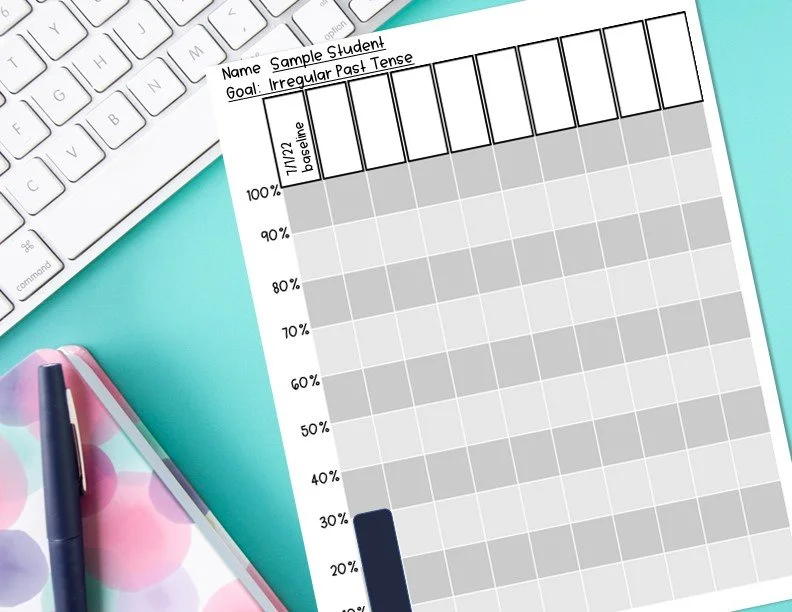
Your student’s performance on the 10 items is your baseline.
You want to be sure not to cue the student or provide prompts. If you do that must be reflected in how you report the baseline.
A baseline can be reported in a % or a #/total trials.
If a student used three irregular past tense verbs correctly I would report their baseline as 3/10 opportunities independently or 30% accuracy independently.
STEP 2: Determine the Progress Monitoring Interval
The next step is to determine how often progress will be measured. This happens at specific and regular intervals and at a separate time from treatment.
At set intervals, you are going to take data on your IEP goals on your data collection sheets. I recommend collecting data on a monthly basis for all of your speech therapy IEP goals.
The benefit of this step is that you do not plan any speech therapy activities or lessons for one week a month. By using this simple system, you plan fewer sessions!
Remember when I mentioned that a simple tweak to your data system would also make therapy easier?!
STEP 3: Write Your IEP Goals to Match Your Baseline and Monitoring Interval
Based on how you are required to write your IEP goals for your school, you will want to clearly state the baseline and the measuring schedule. An example may look like this:
Goal: When presented with a picture and a present tense verb, the STUDENT will independently formulate and say a sentence containing the irregular past tense verb from a baseline of 3/10 opportunities to a level of 8/10 opportunities independently across three consecutive monthly data collection points.
How Goal Will be Measured: Therapist 10-item probe
Expected Level of Achievement: 8/10 opportunities independently
STEP 4: Progress Monitor your Goals with the Same Probes Used for the Baseline
THIS IS AN ESSENTIAL STEP!
Use the identical speech therapy data probes used for your baseline to monitor progress.
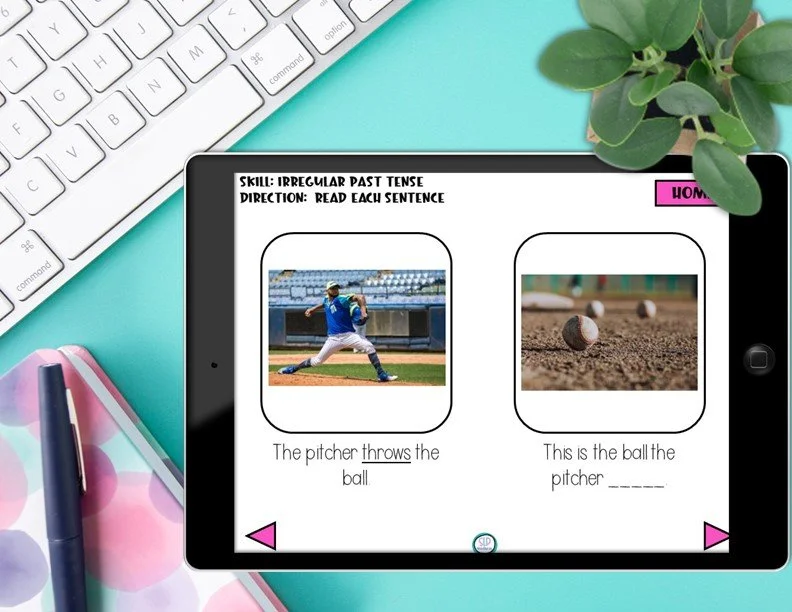
In order to measure actual progress, you want your data to be “clean.” That means, you are comparing an apples-to-apples comparison with the same stimuli, rather than “dirty” data that could be an apples-to-oranges comparison.
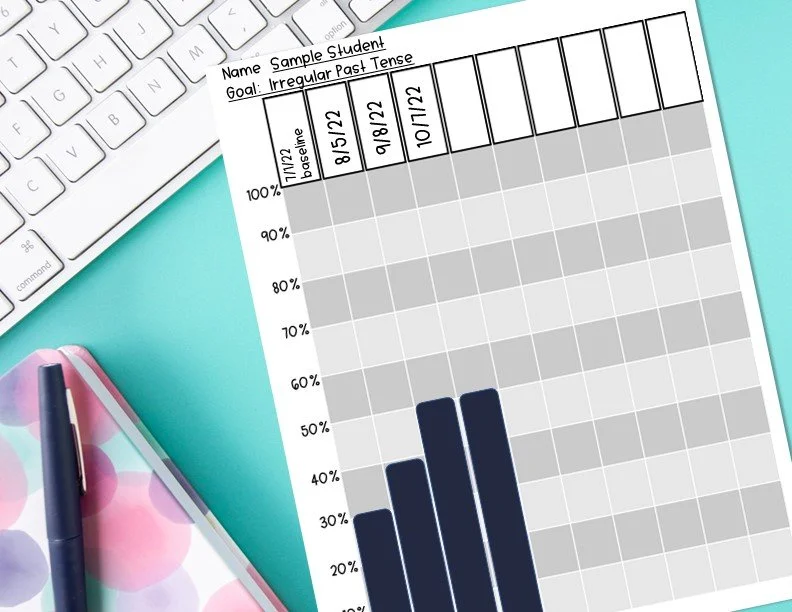
When using the identical data probes you are removing outside influence and other variables that would affect progress reporting.
This is how you truly measure speech therapy goal acquisition.
Your 4 simple steps are:
Gather a baseline using a probe
Set the interval for when you will collect data
Write your IEP goal with the baseline and interval
Monitor progress using the SAME PROBE USED TO COLLECT THE BASELINE
Now that you have the 4-simple steps, take action!
CLICK HERE to get the Probe Sample and get yourself started.
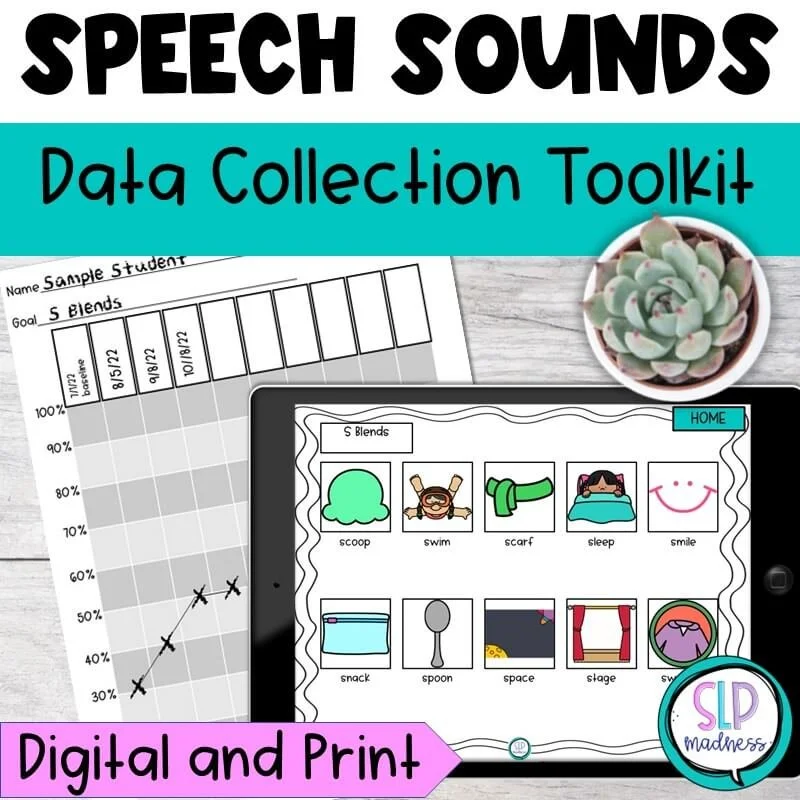
Data Collection Toolkit
Do you need a comprehensive articulation data collection toolkit? These Speech Therapy Data Collection l Articulation Baseline Data Sheets and Probes are just what you need!